
Traditions

AS I TREK DEEPER into what the hucksters call “senior adulthood,” I’m trying to avoid the pitfalls of dogmatism, stubbornness, narrow-mindedness and prejudice. I have almost always preferred Movements over Institutions.

The idea of traditions for tradition’s sake seems unnecessarily rigid and confining to me. To start from a position of “This is the way we have always done it!” thwarts creativity and discovery. A vivid memory I have of kindergarten is of a little girl who sat next to me raising her hand and saying, “Teacher, Teacher, David’s coloring outside the lines; again!”

That’s right B I am, and in fact if I had my way there would be no lines at all, then where would you be?!

Maybe it is old-age creeping in, but lately I’ve been looking for the baby I threw out with that bath water a long time ago.

Tradition is not the worship of ashes, but the preservation of fire."
 —Gustave Mahler

If there is a season that is loaded with traditions it is Christmastime:

  • We always put the tree up on December 1.
  • Where is that star that we always put on top of the tree.
  • We always watch “Christmas Vacation.”
  • We always open one gift on Christmas Eve.
  • There is always a little egg of Silly Putty® in our stockings.

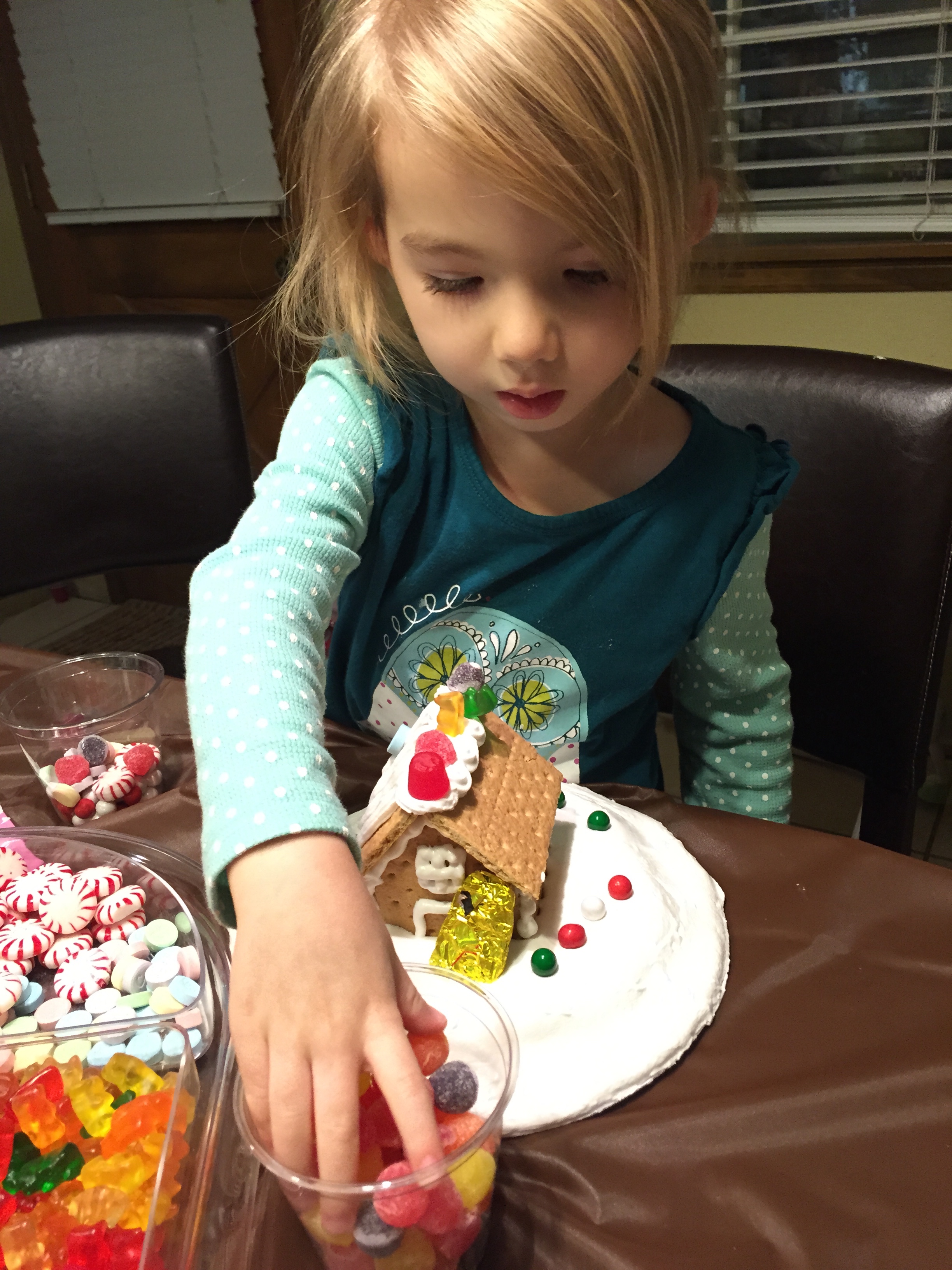
As I sat the other night and watched our Grand-Girls decorate gingerbread houses it dawned on me, my Amazing-Missus has been making these little houses for our two boys, now our Grand-Girls and hundreds of other kids to decorate for more than thirty years. We make gingerbread houses. It’s a tradition and it’s beautiful.

Last Sunday afternoon I sat with my 3 year-old Grand-Girl in my lap waiting for her first performance of The Nutcracker to begin. Next to me was our 6 year-old waiting for her fourth. The youngest was full of questions: Why is it dark in here? Where are the ballerinas? Is this song almost over?

The oldest was fully immersed in the whole Nutcracker experience. During intermission, she danced the first act in the lobby by herself, not caring who was watching. We go see The Nutcracker and after we have cookies and milk. It’s a tradition and it’s beautiful.
Maybe someday they will be too old to want to see The Nutcracker with their Pops. So while they’re off to a movie with some boy who isn't good enough for them, I’ll put Tchaikovsky’s Nutcracker Suite on the record player, and while it’s playing, I’ll remember that once we had a tradition, and it was beautiful.

See, they're not so bad after all. 

A Life, A Rhapsody

I’m not the first to draw an analogy between a life lived and a composition. One of my favorite examples is from “Mr. Holland’s Opus”, a movie I wrote about here. Mr Holland was the band director of a high school for many years. In a scene toward the end of the movie, one of his former students, Gertrude Lang is speaking at an assembly given to honor him:

“There is not a life in this room that you have not touched, and each of us is a better person because of you. We are your symphony Mr. Holland. We are the melodies and the notes of your opus. We are the music of your life.”

What a wonderful tribute. What a beautiful metaphor for a life’s story.

In 1924, George Gershwin composed “Rhapsody In Blue.” It is a classic. It was the hallmark of music scored for orchestra written in jazz forms of the 20s. A rhapsody, and particularly “Rhapsody In Blue”, is characterized by its range of emotion and tonal qualities along with a feeling of improvisation, but with a recurring theme.

A rhapsody is literally an epic poem, written in one movement, recited or played from start to finish. 

I want to tell you of a story of a boy. To me this boy’s life is a rhapsody.

This boy grew up in Lincoln Parish, north central Louisiana, in a little town called Dubach (dew-bach). It was clear to all that love and loyalty for family would be a theme of his life.

I didn’t know him as a boy, but I know from the stories I’ve heard that he made the most of every life experience and relationship. His stories are rich and humble. In fact there is a humility that everyone who knows him, knows is genuine.

There are some things I know for sure about him. He loves music. He was a musician himself. He played the clarinet. I think it’s interesting that “Rhapsody In Blue” starts with a clarinet solo, just as the rhapsody of his life does. He is a great encourager of the musical pursuits of others.

He has never been one to be the center of attention. In fact, he is one of the most selfless people I’ve ever known—always doing what he could to allow others to have their moment in the light.
He reluctantly tells stories of his service in World War II; if you ask.

Just as “Rhapsody In Blue” debuted in 1924, 90 years ago; so did this man. Happy 90th Birthday Dad!

My Dad has provided wonderful guidance and instruction for me all of my life. Some of it has taken, unfortunately some I have squandered. 

Dad never told me I should pray and read my Bible. I came to understand how valuable those things are by watching him practice those disciplines himself. If I am a good husband and a good father and a good grandfather, it is because of the example he has provided.

My Dad understands that the highest calling in life is one of service. It is another of his life’s themes. He has given so much and sacrificed so much—he and my mom both. I look back now on my first drum set and I know that they sacrificed much for me to have those. I know that for my Dad, as a Baptist preacher, to have a son playing drums in a rock and roll band, back in the day when Baptists were particularly concerned about rock music and dancing, must have been difficult. Yet somehow he managed the conflict because he wanted me to love music.

Over the last few years, I’ve watched Dad age with the same grace by which he’s always lived. His eyesight is nearly gone. One day I said something about how hard that must be, yet I never him complain. His reply was, “You know in some ways I see more now than I ever have.”

Here’s the thing about him and those beautiful attitudes of his: “Rhapsody In Blue” is a masterpiece, but only when it is played by master musicians under the direction of a master conductor. Many years ago when my Dad yielded his life to God as an instrument in the Master’s hands, it took. I swear, it’s as if it was his destiny. Thank you Dad for being faithful.

Oh, and those words of Gertrude Lang to Mr. Holland:

“There is not a life in this room that you have not touched, and each of us is a better person because of you. We are your symphony Mr. Holland. We are the melodies and the notes of your opus. We are the music of your life.”

I am honored to be a part of Mr. Fuller's Rhapsody.

What Do You Want?

“I can teach anybody how to get what they want out of life. The problem is that I can't find anybody who can tell me what they want.” —Mark Twain

I’m embarrassed by the number of books on my shelf that share the basic theme of “getting what you want out of life.” You know that ones that start: 5 Easy Steps to This, or 7 Keys to That. And you know what’s even more embarrassing? I’ve read every one of these Be Successful, Be Happy, Be Pretty, Be Blessed, etc. books on that shelf.

I haven’t seen the movie “Gone Girl”; yet. I read the book, and upon completing it, threw it across the room. But I will see the movie. I want to see what director David Fincher does with Gillian Flynn’s screenplay. I’m thinking that the most terrifying thing about this story is there doesn’t seem to be a character in it who has a single worthy aspiration.

Death of a Salesman” is story sort of like that. Poor Willy Loman. I can’t think of a fate worse than having your own son stand over your grave and proclaim of you, “He had all the wrong dreams!”

So, if Mr. Twain could make good on his bold promise,
what would you tell him you want?

I think it is a “big picture” question—you know; not a question like: what do you want to do this weekend, but rather, what do you want them to say about you at your funeral.

As I’ve mentioned before, I’ve been involved in a project called “Storyline”. One of the things I’m learning is that stories (and each of our lives is a story) are either comedies or tragedies. That sounds so reductionist;at first, I refused to accept it. But it’s not as simple as it sounds, even though it’s basically about happy endings and sad endings.

Why would anyone choose a tragic story for their own life? An example: in 30+ years of working with teenagers, many times I saw kids choose a destructive path, sometimes, at least partly, to spite their parents for divorcing and fracturing their family. Not to say that happens every time—it’s just an example.

Many times tragic stories seem to be the only option someone has. Gilda Radner of the original cast of “Saturday Night Live” wrote upon learning of her terminal cancer: “I wanted a perfect ending. Now I’ve learned the hard way, that some stories don’t have a clear beginning, middle and end.”

Back to the abiding words of Mr. Twain, and his scenario of having a mentor or guide who can, not only tell someone how to get what they want out of life, but help them discover what they REALLY want; consider this advice:

Walk right side: safe,
Walk left side: safe,
Walk middle: SQUISH!
—Mr. Miyagi

Not only did Mr. Miyagi show Daniel-san how to win tournament, and get girl; he taught him to aspire to a balanced life. (And to economize speech by eliminating parts of speech like prepositions and articles.)

There are only two lasting bequests we can hope to give our children. One of these is roots, the other, wings. —Goeth

Maybe that’s what I would tell Mark Twain: I want roots and wings. And I want to be known as someone who helped others find their roots and wings. If that’s not too much to ask. Oh, and it would be really useful to learn that rapid hand-rubbing thing Mr. Miyagi does to help aching joints and muscles.


50 Shades of Pops

I KNOW I SHOULD probably create a playlist of high energy tunes for my morning walk--you know to encourage a brisk pace. This morning though, with the player on Shuffle, the first tune in the random draw was "Crying" by Roy Orbison. As I listened I thought, "Get over it Roy! Behind those dark shades she doesn't know you're crying, and probably doesn't care."

Next up was Patsy Cline's, "Crazy."

What is this playlist trying to tell me? 

There's a new book out that sounds intriguing: Roy G. Biv: An Exceedingly Surprising Book About Color. Roy G. Biv is a mnemonic device to help us remember the colors of the rainbow. Red, Orange, Yellow, Green, Blue, Indigo and Violet.

But, (here's an excerpt from the book):

That mnemonic, it turns out, isn’t strictly accurate: “Technically speaking, there aren’t seven distinct colors in the rainbow. But Isaac Newton felt pressured to name seven colors to match the seven tones in Descartes’s musical scale, so he shoe-horned indigo in.”

So how about Black, White and Gray? Well, there's the whole total presence of color / total absence of color thing. But let's not get too technical here. And what about the Shades of Gray? I took a look at Sherwin Williams color selections and found way more than 50. Of course, any of us who grew up with B&W TV know that. And we are very comfortable making sense of it. To this day, I find good B&W photography to be way more compelling than Color.

Well, back to that mournful playlist I started my walk with--I will confess right now that as I tread deeper into this second-coming-of-age, there are times I realize I am crazy (in a lovable way) and I will admit that these days I can get dewy-eyed more often than Meg Ryan in Sleepless in Seattle and You've Got Mail put together. But then so can a lot of the old guys I know.

So I've decided to own my new shades of emotion and personality, although I will say, I don't necessarily enjoy them all. It was easier being just a guy with emotions about a half-inch deep. Now my shades run deeper and sometimes darker. The problem with having more feelings is they get hurt more often. But I'm finding it's a small price to pay because on the other end, in the brighter shades of gray, I'm more aware of the subtle joys and blessings along the way.

Maybe I should have titled this post: From 5 to 50 and Growing--The Shades of Aging. But who would have clicked to read that?! Better to use the 50 Shades title because they thought it might have something to do with the book.

To me one of the saddest things that happens to us humans as we age is that we try to eliminate all shades of gray. Everything, we think, must be Black or White--our political views, our religion, our world view. So we become more narrow-minded, more dogmatic, and just meaner.

Call me Crazy, but I don't want to be that way.

The color of truth is gray. --― André Gide

Speaking of that book: Yes, I did read it (don't judge me), just the first one (of the three). It was repulsive and a poorly told story. Any book that ends with a girl caught in emotional angst because she is looking forlornly at a half-deflated balloon of a helicopter some self-obsessed wacko gave her, is a poorly told story. They only thing that would have made it more ridiculous is if she had been wearying an air-brushed t-shirt he bought for her at the State Fair. I finished it because I don't tolerate people who criticize books or movies that they have not read or watched in their entirety. And that is not a recommendation to watch the forthcoming movie of the same name or to read the book.

Gray hair is God's graffiti. --Bill Cosby

PS: If I could choose one musician to sit in a coffeeshop and listen to for hours it would be Brandi Carlile. She understands how to paint a picture with music. Watch this video of her singing Patsy's song and notice all of the colors of tone and expression that she shows us.