
The Moral Of The Story

THREE TIMES BEFORE, I have written about my favorite movies in posts I call Pops' Flick Picks: The Graduate, Finding Forrester, and Pleasantville. Here's my fourth: Mr. Holland's Opus.

Mr. Holland composed an opus, but not the one he believed he was destined to write. That happens, you know.

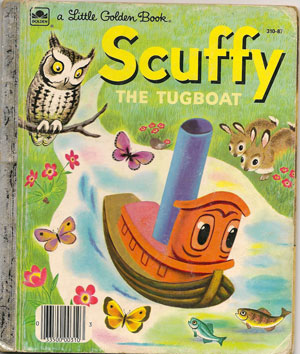
Recently I was giving a talk to a group of business managers. I was trying to make a point using a book from The Little Golden Book series called "Scuffy The Tugboat." This little book was read to me many many times as a child. Still, to this day, I read that book and I am still not certain what the moral of the story is. I know it has a moral; children's books just do, but I can't figure it out. Or, maybe I really have figured it out and just don't want to accept its thesis.

If you're not familiar with the story it opens with Scuffy sitting on a shelf in a toy store. He is obsessed with the sense that he was made for bigger and grander things than sitting in a toy shop. So the shop owner takes the little boat home to his son who quickly sets Scuffy to sail in the bathtub. But this too is unsatisfying and unworthy of the calling Scuffy believes is his.

The little boy takes Scuffy to a stream. Scuffy quickly makes his way to wider and deeper waters and ultimately finds himself overwhelmed with rough seas and the heavy traffic of big ships and other things that go bump in the night.

[Spoiler Alert] Fortunately for Scuffy, The man and his little boy find him on the brink of destruction and rescue him. The story ends with Scuffy happily floating in the safe confines of the little boy's bathtub, content with the realization that this is his destiny after all.

So what is the moral of this story? I really want to know. Don't tell me it is: to be content with your circumstances, to quash any temptation to explore beyond the obvious boundaries. I find that very unsatisfying.

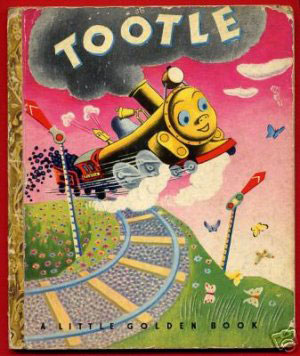
Scuffy The Tugboat was written by Gertrude Crampton, who, not surprisingly also wrote Tootle The Train, the painful story of a little train that learned the hard way that you should always stay on the tracks no matter what.
But maybe Mr. Holland's Opus is a Scuffy story. If it is, then maybe I do get it and can accept it as a valid and satisfying plot line for my life. Like, maybe I wasn't built to be in the big waters, but maybe I can have a significant and worthwhile life anyway.

Here's a line from the movie that will help you see why I think it may be a Scuffy story. This is from a character called Gertrude Lang, one of Mr. Holland's students.

I have a feeling that Mr. Holland considers a great part of his own life misspent. Rumor has it he was always working on this symphony of his. And this was going to make him famous, rich, probably both. But Mr. Holland isn't rich and he isn't famous, at least not outside of our little town.

I hope I haven't already given too much away in case you haven't already seen Mr. Holland's Opus.

Maybe what Scuffy and Tootle and Mr. Holland teach us is that we can learn from others and our own experiences. We can also contemplate our future.

"Neuroscience has long recognized that emulation of the future is one of the main businesses intelligent brains invest in. By learning the rules of the world and simulating outcomes in the service of decision making, brains can play out events without the risk and expense of attempting them physically. As the philosopher Karl Popper wrote, simulation of the future allows 'our hypotheses to die in our stead.'" --David Eagleman, a neuroscientist at the Baylor College of Medicine, writing in The New York Times. August 2012.

In other words, we humans can play what-if. Kids do it all the time when they are playing make-believe. What if this... What if that... They are imagining possibilities, creating story lines. If only Scuffy could have contemplated the "what-if" of being a little toy boat in the deep, storm-tossed seas among the big ships, he could have saved himself the horror of reality. Maybe if he had, he would have known: life in the bathtub isn't so bad--metaphorically.

But, with apologies to Gertrude Crampton, I still contend that occasionally we need leave the tracks, color outside the lines, do something that makes our palms sweaty. To use a Mr. Holland analogy, Ms. Crampton would be happy to just play the notes on the page, when really, I believe God intended for us to be musical: so dance, or sing, or play.

Playing music is supposed to be fun. It's about heart, it's about feelings, moving people, and something beautiful, and it's not about notes on a page. I can teach you notes on a page, I can't teach you that other stuff. -- Mr. Holland

Anticipation

You know the Carly Simon song, "Anticipation"? It starts off:

We can never know about the days to come
But we think about them anyway

We, our family, are in the throes of life's most ancient and wonderful states of anticipation. If fact it is known as "Expecting!" It is so universal that when someone says "They're Expecting." You know what they're expecting without any additional information.

I'm sure right now, if she's reading this, our beautiful and very pregnant daughter-in-law is thinking, "What do you mean WE Ke-mo sah-bee!?" She is obviously doing all the heavy lifting, and other stuff I can't even imagine--having never been an expectant mother.

My Anticipation is easier. I just get to sit and imagine being even Pop-sier (Pops x3).

Back in the day, our cloud of Anticipation was darker. Heck we didn't even know what color to paint the nursery, or which wallpaper to hang: the one with rainbow colored pegasus/unicorns, or the little cowboys.

This is not Nora's actual picture. I "borrowed" it for illustration purposes only.

This is not Nora's actual picture. I "borrowed" it for illustration purposes only.

But we know, because of our complete trust in the doctor's reading of an image on a monitor, that this little baby we're expecting any day now, is a girl. She already has a name: Nora Grace. She has two loving parents, and two big sisters who are about to have their world's rocked.

There are some titles that people seek, you know, like: President, Senator, Miss America. Some are bestowed meritoriously: Homecoming queen, Most Likely to Whatever. Some people bring on themselves: Class Clown, Town Drunk, etc.

Then there are those titles that come by virtue of providence, like: POPS. I've been called a lot of things, but the grandest are Son, Husband, Dad, and POPS.

Today has started as most other days, but today, like yesterday, I am preoccupied--with ANTICIPATION.

Nora Grace, this is your POPS. We're ready when you are. 

Life As Story

FOR A WHILE NOW I've been working on a project called, "Storyline." It's the brainchild of Donald Miller. The project is about creating a life-planning process based on the elements of story and was developed combining the principles of screenwriting and storytelling.

I'm a big fan of Donald Miller--for several reasons: one, he is an excellent writer; two, his ideas of looking at our lives as STORY makes a lot of sense to me.

I love bildungsroman. Some of our most timeless and treasured stories are bildungsroman. You know the ones:

David Copperfield by Charles Dickens
The Adventures of Huckleberry Finn by Mark Twain
This Side of Paradise by F. Scott Fitzgerald
The Catcher in the Rye by J.D. Salinger
To Kill A Mockingbird by Harper Lee
The Outsiders by S.E. Hinton

Bildungsroman are stories where the protagonist "comes of age." They're about maturity, passage, and developing morally and psychologically. This word, according to the Encyclopedia Britannica, is a German word meaning "novel of education" or "novel of formation."

For us Baby Boomers, movies like The Graduate, To Kill A Mockingbird and Rebel Without a Cause are examples of this literary genre. Some of my other favorite coming-of-age films include: Dead Poets Society, The Breakfast Club, Stand By Me, and most recently Wes Anderson's Moonrise Kingdom.

We all have a personal story, we're living it, and sort of making it up as we go. No doubt you remember a version of your first coming-of-age. Maybe it centered around puberty, or a religious event, or a rite of passage like the new found freedom of a driver's license. Maybe it came through a trial of some kind: losing someone close to you, a loss of innocence--something that required you to grow up fast.

Today there is a state or condition called "teen angst". I don't know if it existed when I was a teen or not. If it did, maybe it didn't have a name. In a way, this "second coming of age", as I like to call this time of impending "retirement", has some of the dread, uncertainty, and anxiety that the first coming of age had.

Quote by Donald Miller. Image from Pinterest.

Quote by Donald Miller. Image from Pinterest.

Back to Donald Miller and this whole life as story point of view--Donald wrote a memoir of sorts called, A Million Miles in a Thousand Years: What I Learned While Editing My Life. Here's one of my favorite lines from the book:

“Fear is a manipulative emotion that can trick us into living a boring life.”
― Donald Miller

He's right; you know. Recently I found an Airstream that would have been a great fit for us. It was Used, but in great condition at a fair price. I disguised my fear of doing the deal behind a curtain of being wise and discretionary and responsible. A crock of BS, as the kids say. I was just afraid. Not that this is an example of a life-altering moment, but it is real. 

There's so much more I want to say on this topic, but I'm getting close to the "optimum word count for a good blog post." So I'll sign off with final words from Donald Miller from the same book:

“Once you live a good story, you get a taste for a kind of meaning in life, and you can't go back to being normal; you can't go back to meaningless scenes stitched together by the forgettable thread of wasted time.” ― Donald Miller

P.S.: I highly recommend you watch the movie, Stranger Than Fiction, with Will Ferrell and Dustin Hoffman. It's a great movie about life-as-story.

Branching Out

I am not a dendrologist or an arborist. Heck, I'm not even a genealogist. But if this blog proves anything, it proves I'm not afraid to talk about stuff I know little about.

Several years and houses ago, we lived in a house that had an apricot tree in the backyard. It was pointed out to us that this was a special apricot tree--half the tree produced freestone apricots and the other half clingstone. I pretended I knew what the person was talking about with a surprised look and a "Really?!" 

If you're botany-challenged like me, the seed in the middle of apricots and their cousin the peach is called a stone. Sometimes the fruit clings to the stone, sometimes it doesn't--it's "free." Apparently our special tree was the result of a "graft" of two varieties.

Wouldn't family trees be more interesting if we could graft branches and twigs together? Like I said, I'm no expert, but it seems to me like this happens all the time, with wonderful results. When it does, people say things like, "He or she is like family to us." What a beautiful thing that our "trees" can branch outside the biological ties that bind.

I've always enjoyed watching basketball. I especially enjoy women's games because it seems that there's more finesse, strategy, and teamwork involved. Over the past few years, we've followed the women's team at Oklahoma Baptist University. It didn't happen randomly. Our two grand-girls live near OBU, their Daddy teaches there.

"Sisters" Harper, Allie, Karlee

"Sisters" Harper, Allie, Karlee

At OBU they have a tradition (in fact they seem to have hundreds of traditions) where families "adopt" one of the players. So four years ago, our son and his family adopted an incoming freshman from Houston named Allie. Allie didn't really need more family. Turns out she has a wonderful family back in Houston. But somehow when you graft branches together it takes nothing away from either tree, but results in something that enriches everyone.

Not only has this provided an opportunity to watch and cheer for this spunky, speedy guard and her teammates, but it has been so fun to watch the grafted relationship of two families become something, well, special. 

Allie is a senior now, wrapping up a very successful season with this team that could contend for a national championship. But more importantly she is a joy and someone very special to my grand-girls and their parents and therefore to me too. Thank you Allie. Welcome to the "family."

#5 Allie Brandenburg (photo borrowed from the OBU Athletics website without permission)

#5 Allie Brandenburg (photo borrowed from the OBU Athletics website without permission)